Wednesday, 20 June 2012

Urban Baskets at the Harley Gallery


Photo courtesy of Harley Gallery

After almost two years of touring ‘Urban Baskets- tradition recycled’ is now open at its last planned UK venue, the Harley Gallery Welbeck, Nottinghamshire  where it will remain on show until the 12th August.

Whilst there remains the possibility of it being seen in other countries, the current economic situation is making it very hard for public venues in the UK to take on non-commercial touring shows. For the same tedious, and, in my view, totally preventable, reason there is no official opening planned at the Harley. Consequently  I have not seen its installation and unless we get enough students enrolled at the workshops planned for the 28th and 29th July I will not be able to see it, as I do not travel unless there is a genuine purpose to the voyage. Just looking at my work in a new venue doesn’t really count as such!

Stacking laundry basket, painted cardboard and recycled plastics, 1991


So, if you want to learn how to make simple functional baskets that will give you a huge amount of satisfaction in learning a new skill whilst recycling some things, sign up for the workshops, and with your help I may get to see the exhibition in it’s final UK venue.

Meanwhile if you get to the exhibition before me I would like to hear what you think of it, you can use the comment form or email me, either are welcome.


Friday, 18 May 2012

Plaiting and Coiling Workshops, Harley Gallery

Coiling experiments
If  the last blog has inspired you to have a go,  there are two workshops planned to coincide with the last showing of Urban Baskets in the UK at the Harley Gallery, Nottinghamshire.
On Saturday 28th July I will teach you how to plait tetra paks (among other things) and on Sunday 29th July it’s looping and coiling with recycled materials. Both are open to anyone, beginner or not. For full details look here. Bookings are now open.

Thursday, 10 May 2012

Tallers and Tetra Paks


 Plaiting workshop at the Taller Cestaria, Lugo 2009
It is almost two years since I last taught at the Taller Cestaria run by CENTRAD in Lugo, Galicia.  It was, as usual, great fun, a recycling workshop (you can see pictures and read about it here) with very creative students. But, towards the end of the week the atmosphere began to change as rumours had begun circulating that the administration of the Taller was to be taken out of the hands of Carlos Fontales, who, in the opinion of anyone who had ever had the pleasure of teaching or learning there was the reason why it all ran as well as it did.

Although it was always hard work and exhausting for me to teach there (due to my very poor Spanish) the students always engaged fully with an enormous enthusiasm to learn, experiment and share these experiences in each others company. All of which contributed to the special atmosphere that existed there. In retrospect we know that the changes that subsequently came about were really only about the financial situation in Spain. But, at the time, many of us who knew how good the place was, sought to prevent them happening by protesting vociferously and publicly, none of which had any effect, of course! CENTRAD runs very few basket making courses now and those that take place lack the breadth and depth of topics of those that Carlos organised.

Flors shoes for a wedding
Recently I have been reminded of all this because a couple of my former students there have contacted me, they are as sad as I am that this once excellent environment for basket courses has been so diminished. One of them, Flor Perez, was a regular in my workshops, a teacher of, and activist for, people who have problems of various sorts in their lives. Flor initially came to my workshops looking for things that she could teach to some of these people and she always surprised me, and everyone else, with her creativity; a pair of tetra pak pointy shoes for a wedding, a somewhat surreal looped lace umbrella (given the propensity for rain in Galicia) and a cardboard suitcase were just some of the delights.The other student was Zoila Gulin who makes  bags and baskets out of tetra paks when she isn’t using her advocacy skills helping 'creatives' with intellectual property rights!

Jose Manuel with part woven basket!
Flor contacted me because she wanted me to see some pictures of work done by a friend of hers whom she had subsequently taught to plait tetra pak baskets. Jose Manuel now seems to fill all his spare moments with cutting and weaving tetra paks into bags and baskets of all kinds, inventing new forms and apparently getting a huge amount of pleasure and satisfaction from doing so. A large pull-along basket on castors, to carry towels from the family run centre for alternative therapies to the laundry, is my particular favourite. It is both functional and attractive and I don’t doubt that if Jose Manuel continues to enjoy making baskets with tetra paks more gems will appear.

Pull along laundry basket by Jose Manuel
It feels as though tetra pak weaving has always been part of my life but, in fact, I first used juice cartons to make baskets with in 1991. I had not seen them used by anyone else in the same way but, as the internet was still a dream for most of us at that time, it was of course always possible that someone somewhere else in the world had also spotted their potential. My use of them was, however, part of a logical progression in my work because I had started to look for materials that were already coloured so that I could move away from using dye and paint. The first baskets I made with tetra paks were assembled rather than woven, each whole carton being stitched to the next to create sheet material for bowls and laundry baskets.
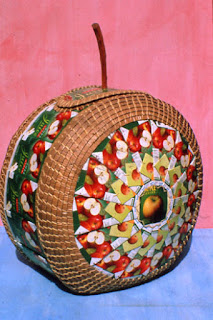
Apple juice carton laundry basket 1995
In 1991, London, where I lived, was still a back-water as far as recycling went. A recently published article about my work suggested that I had raided my ‘recycling box’ for materials at that time; nothing could be further from the truth. We certainly did not have recycling boxes then and even after they were finally introduced it was still some time before tetra paks could be recycled. The layers of aluminium, paper, printing inks and plastic used to make the cartons were, and still are, a challenge for industrial recycling requiring considerable energy to separate the various elements. The cartons came into my house full of juice and left as baskets. If I had been able to put them into a ‘recycling box’ it is entirely possible that I would never have used them. I think it was the fact that they were being thrown away in almost mint condition that both upset me and inspired me to try and make things with them.

Handbag 1997
It wasn’t until 1995 that I discovered a way to cut the cartons that gave me long strips to to plait with. It seemed a perfect match of material and technique, the tetra pak being flexible, strong and relatively waterproof it also had, for me, the added bonus of colour. Since then many baskets and other objects made with milk and juice cartons have come and gone through my hands. Through classes and books I have also taught many other people how to do the same yet, I rarely hear what effect this has on other people lives. As a teacher one accepts that the knowledge passed on to others becomes theirs to do what they like with, without any expectation of further acknowledgement or credit.  Nevertheless, it is always a delight to hear of the ways in which this knowledge has been passed into another pair of hands, and how it has been adapted, or added to, by them. Even if the Taller is no longer the place it was, it is good to know that the knowledge imparted there lives on in the hands of Flor, Jose Manuel and Zoila, among others.

Thursday, 19 April 2012

Baskets, Birds and Bavarian Slippers


It seems to me that there are some days when there are a series of malicious events just waiting for you to get out of bed so that they can ruin your day. It is as though they have arranged it amongst themselves. And then there are some days that are filled with precious little delights that also seem to have formed, what I suppose one might call, a  ‘glee’ club and last Saturday was one of those.

Emmaus had an all day event on and, as I furnish my home and clothe my body with other peoples cast offs, it was too tempting to pass by. I was rewarded not only with a lack of crowds but, with two more dirty, broken and abused Charente baskets and a pair of seemingly unworn Indian woven leather shoes, that fitted, all for 5€.

Walking down the road with my treasures I bumped into Sam, owner of MaBootique a vintage clothes shop, who told me that there was a pair of slippers waiting for me at their house nearby. What a lovely present Miles had found for me. They were extraordinary, clownish,  plaited straw Bavarian slippers that just made you want to smile.


Onto the market where I spotted and chased down a blue coil-plaited strapping tape basket and its owner, neither of which I had seen before. She was in a hurry, or quite possibly I frightened her rushing at her brandishing the camera. But, she did tell me, just before she ran away, that she had bought it in Morocco from a man who usually makes the palm leaf version. I have seen similar ones in Spain but the colours, translucency  and  immaculate technique made this one particularly good, and brought back some special memories of learning the technique from a group of elderly women in Mallorca.


After this excitement the supermarket seemed more tolerable than usual and then became way better than usual when I noticed a sparrow tucking into the mushrooms. After gorging itself on the champignons de Paris and pecking tentatively at the pleurottes it flew up into the artificial orange tree that dangles its moribund plastic foliage over the produce counters. 
Sparrow and its reflection

Does it live in the supermarket all the time, does it know what life is like out of doors, or has it found a way to enter at will when it fancies something other than insects for dinner? Oblivious to the security gates, security tags and security guards with their punk collared security rottweilers, this little bird thieves at will and as it does so nibbles and pecks at the profit margins…. go for it little bird ! 

Wednesday, 4 April 2012

Disegno


At the Museum of Modern Art, Wales in Macynthlleth there is currently an exhibition of sculptors’ drawings until the 5th May. Disegno, as it was called by its curator Stephen West, aims to demonstrate the role that drawing plays in the creation of 3 dimensional work for some artists. I was invited to include some of my drawings from my sketch books and a piece of work.

Drawing is something most of us do if we go to school. It is something that most of us stop doing when teachers, or friends and family, tell us that we aren’t doing it correctly, because it doesn’t look anything like the thing we are trying to draw. Some of us are either stubborn or become addicted to the process, or both, and continue to draw as adults. According to my mother, it was always easy to keep me happy as a child with a scrap of paper and a pencil. The only time I ever remember being even slightly discouraged was when my drawing of a Labrador dog made my father laugh because he said it was a dead ringer for General de Gaulle.

At art school the foundation of everything we did was the sketch book. We were encouraged to carry it everywhere and to use it daily to record anything and everything.
But the fact that the ever present book would occasionally be scrutinised by our tutors, meant that, for me, it became a self conscious activity. It was something that needed to be done in the right way, in their eyes ….whatever that might be, and I was never really sure.

It wasn’t until nearly 10 years after graduating, when I started making baskets as opposed to cane sculptures, that drawing suddenly took on a whole new meaning for me. Basket weaving is slow work, requiring a heavy investment of time, so I began to use drawing to resolve aesthetic and technical problems in order to avoid having to undo hours of work. I have not stopped drawing since.


I use graph paper for emotional and practical reasons. The expensive black bound sketch books we were encouraged to use at college terrified me; I never felt that any marks that I might make in them could improve such perfect white paper. Graph paper makes no such demands and can help with scale. My sketch books have also, with time, become valuable to me as diaries and records of work.

For the first time in 30 years I have put a sketch book on public display, and I am now worried that having done so may inhibit me again, as the tutors scrutiny did then. But just possibly, it may be that I have finally grown up enough to not worry about what other people think about my sketch book. I really hope so.

You can read more about the exhibition here.http://www.momawales.org.uk/?page_id=384

Thursday, 23 February 2012

Straws in the Wind

Coiled Shetland oat straw basket made by Jimmy Work
Oats were the staple grain in the Shetland Islands prior to the 20th Century and as in all rural communities at that time their use was completely sustainable, nothing was wasted. The threshed grain used for porridge, flour and animal feed was ground by small water mills set in the burns. The remaining straws were then used for things such as  roofing, stuffing mattresses, wrapping the feet in cold weather, mats for threshing, animal bedding and costumes for festivals. And, as in so many other rural communities all over the world they were also used for making baskets.

Image taken from an old postcard showing large coiled straw basket 
These islands are thought to have been inhabited for at least 5000 years but there is little evidence to suggest that there was ever a strong tradition of weaving with woody plants. There used to be trees in Shetland but they disappeared a long time ago, so for centuries there were few indigenous materials for basket making, little willow or hazel, certainly no oaks, ashes or chestnuts. Consequently the baskets of these islands had to be made with the native materials that could be gleaned or grown, such as oats, dockens, bent, rushes and heather.There was no riving, skeining or plaiting of anything tree or bark like, just the softer more textile tradition of twining, and for sturdier items, coiling. No axes or woodworkers 'donkeys' were involved just hands and pocket knives and bone or driftwood needles.

The Shetland Islands have a long tradition of spinning, knitting and weaving the fine wool that the indigenous sheep provide. This was the job of the women; basket making was the domain of the men and was an activity for the winter when the weather and short days forced them indoors.

The oats that grew here in the 19th and 20th Century here were different. They were fine and  stayed green and softer for longer making them ideal for basket making unlike the nitrogen-fuelled cereals  of today,  bruisers by comparison, short, muscular, and brittle. Now there are few people who grow these oats and those that do provide specialist needs such as value added local oatcakes, the roofing of a few listed buildings and the last semi-professional basket-maker Jimmy Work who only uses Shetland oats.

Jimmy Work in his 'real' indoor  work place 

Jimmy and selection of his baskets in  a 'staged' work place made for  a 1998 Calendar .
Photograph by Bill Jackson  for The Shetland Times.


Jimmy started making baskets in 1958 and he hasn't stopped. He says he taught himself and today at 88 he still makes the fine simple elegant coiled baskets that have become his trade mark. These are not traditional agricultural baskets like the kishie or fishing baskets such as the budie, these are domestic baskets for laundry and knitting, to hold peats by the fire. These are 1960's post herring trade, oil boom baskets used to decorate the home with in a much less hard and more leisurely life.

Jimmy has made hundreds of them, he doesn't know how many, and they have been sent to all parts of the world - he is a one man industry. His hobby, for that is what it is, has created a tradition and people come from all over to film him, talk to him and buy his baskets. Jimmy sells everything he makes and selling them is very important to him, he has little time for people that visit and do not buy! Most of his working life he spent painting and decorating for a building contractor, with his basket making almost a second job. He worked at it for an hour in the morning prior to the day job and several hours in the evening on his return home after a long day with the paint brush.


Jimmy says he can always recognise his baskets because he makes them without adding extra lines of stitching on the sides. There is the same number of stitches at the edge of the base as at the top edge regardless of any outward flow of the form. They are beautifully crafted, sturdy, functional and elegant baskets. He has never had any desire to alter his technique or his materials and it is probably because he has always made them the same way that they are so good.
Base of the basket

I asked Jimmy if he had ever taught anyone else to make them. I had heard whispers on the wind that he had refused to teach a woman who had offered to pay him for tuition. Apparently he told her that a woman would never have the strength to do it. I didn’t ask him if it was true, nor did I dare tell him I make baskets but I am very glad to hear that he is now passing on his precious knowledge to a couple of people – both male!  

Wednesday, 15 February 2012

Skeklers Hats

Lerwick Up Helly Aa 2012


Guizing is an important part of cultural life in the Shetland Islands. Nowadays it happens at Halloween, Newerday (New Year) and most famously at Lerwick Up Helly Aa on the 31st January. In the past it also featured as part of wedding festivities.

'Guizing' is the Shetland verb for the art of disguising yourself in 'fancy dress' which now can be anything from 'Teletubbies' to Elvis impersonators.  Traditionally an activity for adult males and children of both sexes, it is now acceptable for women to participate in local guizing events. Lerwick Up Helly Aa, however, still remains the preserve of males.

 In the Northern parts of the Shetland Islands i.e North Mainland, Yell, Unst and Fetlar once dressed in your guizing outfit you became a “skekler”.  These slightly devilish creatures had licence on these special occasions to visit peoples homes and to say and do things that may or may not have been acceptable without the disguise. It is not hard to imagine that in some of these small and self contained communities, sometimes ruled with an iron hand by the landowners, it acted as an important  safety valve allowing resentments and frustrations to be expressed without reprisal. In some ways it appears to still perform the same role as at the halls at the winter fire festivities  guizers perform comic acts that poke fun at people who, in some way or another, might have offended or amused the community. There is no hiding place for the victims they just have to accept their critique, in the knowledge that they have an equal right to do the same to others.

Before the arrival of new materials and a money based culture, the skeklers costume comprised   a pointed hat decorated with ribbons, a cloak, skirt and leggings all of which were made out of oat straw.  Terry Gunnel, Professor in Folkloristics at the University of Iceland, is an expert on the guising traditions of this part of the world and  notes in his paper  "Grýla, Grýlur, "Grøleks" and Skeklers: Medieval Disguise Traditions in the North Atlantic?"Arv: Nordic Yearbook of Folklore, 57 (2001), 33-54. the last practical recorded complete skeklers outfit as having been seen on Fetlar in 1958. Consequently, for the opening of the the new Shetland Museum in 2007 Euan Balfour was  commissioned to recreate a skeklers  outfit based on information in photos and recordings in the archives as by then only two  skeklers hats were known to still exist in the islands.
Euan Balfours re-creation of a skeklers outfit in the Shetland Museum
One of these two hats was made by my great uncle Andrew Anderson for his daughter. Its a fine example decorated somewhat quirkily with neck ties! 
Skeklers hat made by Andrew Anderson.

So in a bid to revive the tradition and to help me understand the processes involved I decided to make one this year for the male in the house to wear out guizing in North a Voe. I had oat straw given to me by Hazel Gray who is one of the few to grow it now and I decided to use rope found on the beach for the weaving and plastic bags for the ribbons. Without the original in front of me I worked from memory and consequently had to redo a few bits but on the whole it worked out fine, if a little improvised.


The first house on the guizing route ( there were over 20 on the route and in each house a dram is taken!) belongs to Robert Williamson, aka Robert o’Camb, who it turns out used to be a dab hand at making skeklers hats though he hadn't done one for years. He spotted my version straight away and told the brave wearer that whilst it was 'no’ a bad effort ' it wasn't in the North a Voe tradition but that he would be happy to enlighten me. A subsequent visit to Robert filled in some more detail. It turns out that each community had different ways of making it, the most significant difference being whether it was intended to be worn over the face like this...... 


or with a veil covering the face. Uncle Andrews from Cullivoe was to be worn covering the face and the North a Voe variety with a veil. There are other differences but suffice to say, for the moment, that as with most things the “devil is in the detail”!
Robert Williamson wearing his North  a Voe  hat - without the traditional  veil.